


Greetings! Welcome to the inaugural issue of Infrastructure Weekly, your roundup of Malaysia’s key project developments and policy shifts. In this edition (covering May 1–7, 2025), we spotlight major progress on a national rail megaproject, quick updates from the field, a policy brief, and what to watch in the coming days.
ECRL on Fast Track to Completion (Featured Story)
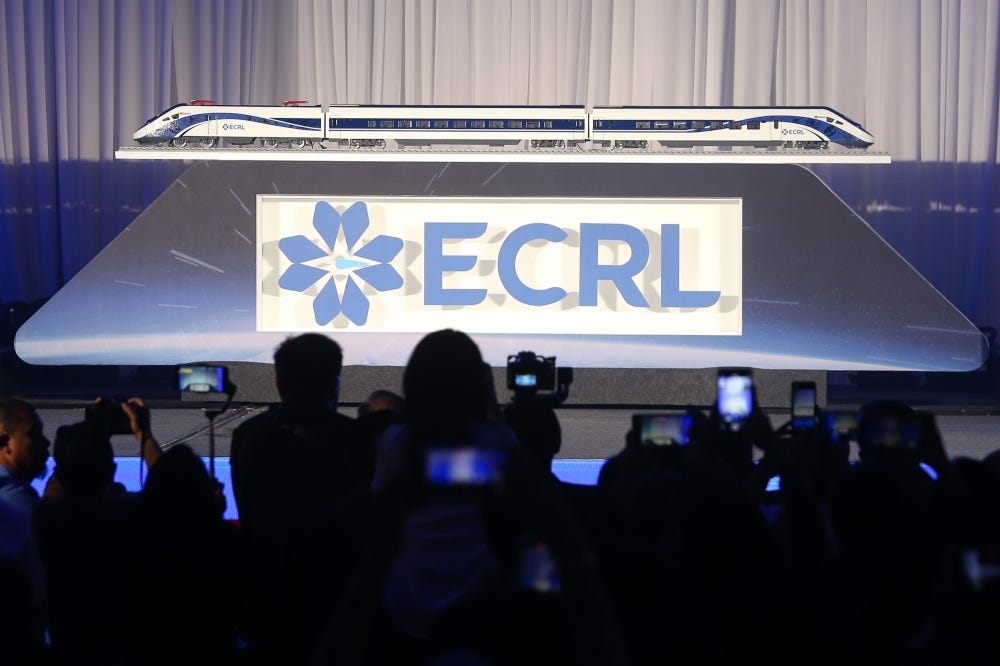
A model of the ECRL train and logo on display. The East Coast Rail Link is one of Malaysia’s largest ongoing infrastructure projects.
Malaysia’s East Coast Rail Link (ECRL) marked a significant milestone this week, reaching 82.45% completion as of April. According to Transport Minister Anthony Loke, over 400 km of main-line track have been laid – from Maran, Pahang to Kota Bharu, Kelantan – finishing two and a half months ahead of schedule. This clears the way for the next 100 km of track installation toward Bentong, slated to finish by end of June. Station construction is on track for completion by mid-2026, gearing up for the ECRL’s operational launch in January 2027.
Beyond construction, preparations for operations & maintenance (O&M) are in full swing. The government has formed ECRL Operation Sdn Bhd to manage the line and is training a local workforce to run it. In fact, 210 Malaysian trainees will undergo a year-long railway engineering program in China, with the first batch departing mid-May. Once in service, the 665-km ECRL (connecting Kelantan to Port Klang) will run modern six-car EMU trains at 160 km/h, slashing travel time from Kota Bharu to Gombak (Kuala Lumpur) to just 4 hours. Officials are optimistic this rail link will not only improve connectivity but also shift freight from road to rail – easing highway congestion and cutting carbon emissions in line with national transport policy. All eyes are on the ECRL as it races toward completion, promising a new backbone for Malaysia’s east-west connectivity.
On the Ground
Pahang Boosts Growth around ECRL Stations: The Pahang state government announced high-impact development plans at 7 upcoming ECRL stations to spur local economies. Within a 15-km radius of each station, authorities will roll out new infrastructure and public facilities under transit-oriented development (TOD) schemes. Planned projects include an integrated transport terminal in Bentong, a smart city in Temerloh, and even a maritime hub in Kuantan’s port area – aiming to transform these station areas into vibrant growth centers as the rail comes online.
Selangor Fast-Tracks Flood Works: In response to recent flash floods, Selangor is expediting 17 flood-mitigation projects in Klang district. State exco Izham Hashim said works will target 13 flood hotspots, including Meru and Pandamaran. These projects involve widening key drains, installing larger culverts, and upgrading bridges in vulnerable neighborhoods. The accelerated efforts are expected to improve drainage and reduce the risk of continuous flooding in Klang’s worst-hit areas.
KL–Bangkok Rail Link Revival: Malaysia and Thailand have agreed to revive a direct Kuala Lumpur–Bangkok train service by the end of this year. Using existing KTM and State Railway of Thailand tracks via Padang Besar–Butterworth, the route can be launched quickly without new construction. Both rail operators have been given three months to iron out coordination, ticketing, and schedules. Once up and running, this service will restore convenient overnight travel between KL and Bangkok, boosting tourism and cross-border business ties.
Policy Watch
Freight Shift to Rail: A notable policy emphasis is emerging on greener freight transport. The Transport Ministry is pushing to move more cargo by rail instead of road, leveraging projects like the ECRL. The goal is to curb highway congestion and lower emissions. This shift in strategy, aligning with Malaysia’s low-carbon and logistics efficiency goals, signals new opportunities in rail freight services and terminals.
Global – Hydrogen Pipeline Initiative: Internationally, Israel approved a bold infrastructure plan this week – a 400 km national hydrogen pipeline to supply cleaner fuel to industries. The project, stretching from the northern Jezreel Valley to the Red Sea port of Eilat, is aimed at cutting emissions by delivering hydrogen to factories currently relying on fossil fuels. Notably, the venture will be privately funded and is fast-tracked with planning due by year-end. Malaysian professionals are watching such developments in sustainable infrastructure financing and clean energy delivery, as they could inspire similar initiatives in our region.
Next Steps
Looking ahead to the coming week, the first cohort of ECRL trainees – over 100 young engineers – will depart for China on May 15th to begin their specialized training. This marks a key step in building local expertise for the rail’s future operations. Industry watchers are also anticipating early signals on other big projects in the pipeline. Keep an ear out for any updates on the KL–Singapore High-Speed Rail revival and the upcoming MRT3 Circle Line tenders – any movement on these fronts will be eagerly noted by stakeholders. Stay tuned for more developments in next week’s issue of Infrastructure Weekly!