


🛠️ Tech Weekly
For years, construction tech meant software: drawings on screens, schedules in the cloud. That is changing fast. In the past week alone, Japan’s Kajima put AI-driven robot dogs on its sites, Taisei showed a self-driving tunnel-boring machine beating veteran operators, and France’s Bouygues tested a bricklaying robot that builds 60 square metres of wall a day. Physical AI has arrived, and Malaysian sites are next.
What “physical AI” actually means
Most AI in construction so far has lived on a laptop: reviewing drawings, forecasting cost, or spotting clashes in a BIM model. Physical AI is different. It puts sensing and decision-making inside machines that move around a real site, read changing conditions and act on them, with people supervising rather than steering every move.
The difference matters because the industry’s biggest pain points are physical: progress checks that eat an engineer’s afternoon, repetitive heavy work, and a persistent shortage of skilled hands.
Japan and Europe set the pace
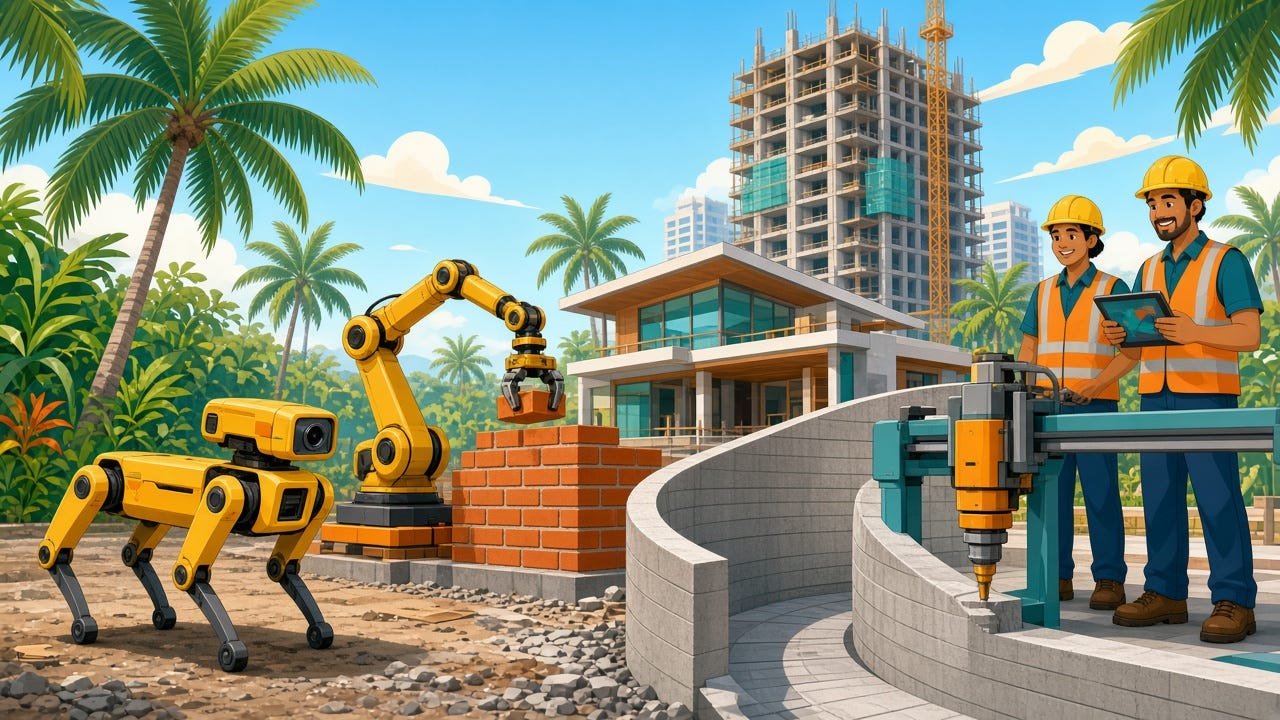
Robot dogs on patrol. On 5 November 2026, Kajima announced the full-scale rollout of quadruped robots running autonomy technology from US-based FieldAI, as reported by Nikkei. Each robot carries cameras, LiDAR and an edge-AI unit. On its first run it explores the site and builds a 3D map, then patrols on its own, avoiding obstacles, updating the map as the building changes, and capturing 360-degree photos and colour point clouds. Because it navigates without satellite positioning, it works indoors and underground. Kajima says the system has already been used at more than 10 sites in Japan and has logged over 2,000 autonomous patrols, for progress records, security support and disaster-recovery surveys.
A tunnel-boring machine that drives itself. Nikkei Asia reported on 6 November that Taisei had demonstrated AI-guided autonomous operation of a tunnel-boring machine, with the self-operating system outperforming experienced human operators in precision. The company frames it as an answer to Japan’s labour shortage.
A robot bricklayer. Bouygues Construction trialled “Walter”, a robot built by Wienerberger and KM Robotics, at its Scale One robotics test platform south of Paris. It laid 5 to 6 square metres of wall per hour at cruising pace, with peaks of 10, for roughly 60 square metres a day, using adhesive foam instead of mortar and no scaffolding. The makers rent it with an operator and charge per square metre, and Bouygues plans to take it to live sites in early 2027.
Research for the long haul. Obayashi and Tohoku University opened a five-year co-creation institute on 1 November 2026 to link physical simulation, robotics and AI with field testing on construction sites.
Malaysia already has a head start
Malaysia is not starting from zero. As software engineer Yi Sien (Ian) Ku noted in a Bernama interview on 5 November, Gamuda’s autonomous tunnelling technology, developed by local engineers, already uses AI to control key operations of tunnel boring machines. That is the same class of capability Taisei has just showcased in Japan.
3D construction printing is also moving off the drawing board. V3D Asia, through its Malaysian arm Nuvah Sdn Bhd, said it aimed to start building Villa Bayu, billed as Malaysia’s first 3D-printed luxury bungalow, at Eco Majestic in Semenyih, Selangor, in November 2026. Nuvah is working with CIDB to make 3D construction printing the seventh system under the Industrialised Building System (IBS) framework, and with Sirim Academy on the country’s first 3DCP standards.
Talent is being built too. In Kuching on 6 November, the Centre of Technical Excellence Sarawak (CENTEXS) held an Innovation Pitch Day on AI and cloud for construction. The winning team, Garuda Qualities, pitched Pantau AI, a defect-management system in which inspectors photograph cracks with a reference object to estimate their width, pin each defect to a 3D building model and issue repair tickets to subcontractors, while human inspectors still sign off.
What it means for Malaysian contractors
Start with data capture, not humanoids. The quickest wins are robots and tools that record what is happening on site: scans, photos, progress and defects. That data feeds the BIM and digital platforms many firms are already adopting, and it is the cheapest way to learn how autonomy behaves in tropical heat, rain and dust.
Think in rental and per-unit pricing. Walter’s “pay per square metre” model is a useful template. Few Malaysian contractors will buy a robot outright, but many could trial one on a large, repetitive scope such as warehouse walls or long tunnel drives.
Standards decide the pace. The 3DCP push shows the path: a system becomes bankable once it is recognised under IBS and backed by standards. Contractors and developers who join those working groups early will shape the rules rather than react to them.
Keep people in the loop. As one speaker at the CENTEXS event put it, AI can optimise a schedule, but it cannot motivate a team on the ground. Accountability for safety and quality stays with people, and the strongest pilots are designed that way from day one.
The bottom line
Physical AI will not replace site teams any time soon, but it is already doing the walking, measuring and repeating in Japan and Europe. With Gamuda’s autonomous tunnelling, a 3D-printed bungalow breaking ground in Selangor and young Sarawakians building AI defect tools, Malaysia has the pieces. The task now is to pilot, measure and scale.
Sources: Nikkei (5 Nov 2026), Nikkei Asia (6 Nov 2026), Kensetsu-Gijutsu.com (8 Nov 2026), RealTech Media (8 Nov 2026), Physical AI News Japan (6 Nov 2026), Bernama via Asia News Today (5 Nov 2026), TVS Sarawak (6 Nov 2026), The Edge Malaysia (1 Sep 2026).