


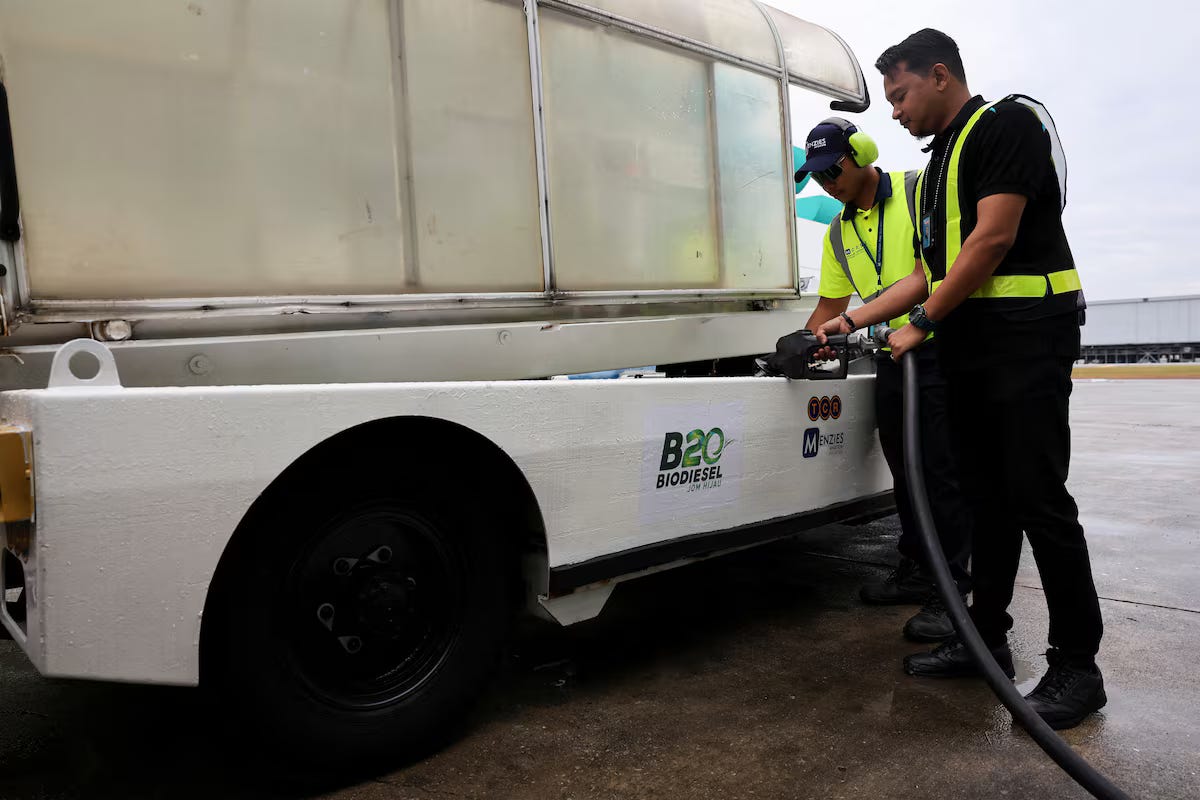
Malaysia’s decarbonisation drive picked up speed this week: the nation’s busiest airport shifted its ground fleet to palm-based B20, households got another slice of rooftop-solar quota, and Sarawak laid out a detailed blueprint that hard-codes circular-economy targets to 2030. Abroad, a UK consortium proved you can turn captured CO₂ into limestone aggregate at industrial scale — opening a new playbook for low-carbon concrete.
Feature Story · “B20 at the Runway”
Malaysia Airports Holdings has switched every tug, belt-loader and catering truck at Kuala Lumpur International Airport (KLIA) from fossil diesel to 20 % palm-biodiesel (B20). Announced on 29 May by the Plantation & Commodities Ministry, the upgrade is projected to cut 15 000 t CO₂e per year and will serve as the test-bed for rolling B20 to the country’s main seaports later this year. The Malaysian Palm Oil Board notes that an airport-wide rollout consumes roughly 10 Ml of biodiesel annually, providing a stable outlet for smallholder harvests while shaving Scope 1 emissions for airlines that book ground-handling services. For construction firms operating air-side projects, the message is clear: low-carbon fuel is no longer a fringe experiment but a procurement requirement in regulated zones.
Quick Hits
Solar for Every Rooftop. PETRA has added 100 MW to the Net Energy Metering (NEM) Rakyat programme, lifting the total quota for residential PV to 600 MW. Applications for the new block opened on 26 May and will close once subscribed or by 30 June 2025 — whichever comes first. Contractors and EPCs targeting the small-scale PV market now have a fresh pipeline of roofs to chase, but speed is critical: the previous tranche filled in just seven months.
Putrajaya’s Solar Walkways. The federal government confirmed plans to install PV-topped walkways and parking pergolas in Putrajaya as a showcase for net-positive public spaces. The pilot, highlighted in an EnergyWatch briefing, will feed surplus power into nearby government buildings and act as a living lab for glare, heat-island and maintenance data. If successful, the design standard is expected to migrate to new RFPs for transit-oriented developments around Klang Valley MRT stations.
Global Lens — CO₂-to-Stone. UK start-ups Mission Zero Technologies and OCO Technology have switched on a plant that captures atmospheric CO₂ and mineralises it into manufactured limestone for concrete and asphalt. The Norfolk pilot locks up 250 t CO₂ per year today, but the modular skid is designed to scale rapidly and reach cost parity with quarried aggregate within five years, according to the partners. Malaysian precasters eyeing export markets with embedded-carbon limits should track this tech closely.
Regulatory Watch
Sarawak Sustainability Blueprint 2030 launched on 29 May, setting 10 strategic thrusts, 48 strategies and 111 action plans that will filter into every state-funded tender. Expect mandatory carbon-reporting templates, lifecycle assessments on building materials and preferential scoring for MyCREST- or GreenRE-certified projects above RM50 million. Contractors bidding in East Malaysia should update their ESG evidence folders before Q4 pre-qualifications kick in.
Green Tip — “Fuel-Switch Pilot on Site”
Pick one high-hour piece of mobile plant (e.g., a telehandler) and trial a B20 blend for two weeks. Log engine hours, fuel draw and any gasket inspections in your telematics platform. Early KLIA data shows no performance hit and a 12–15 % tank-to-wheel CO₂ cut. The recorded savings help you claim MyCREST Energy & Emissions points and bolster client ESG reports.
Keep B20 in your equipment options list, lock in rooftop-solar deals before the quota vanishes, and read Sarawak’s blueprint—policy winds are blowing firmly toward low-carbon builds.