


🏗️ Infrastructure Weekly · Tuesday, 3 November 2026
A railway can be 98 per cent built and still not carry a single passenger. That is the stage Malaysia’s biggest projects have reached. The East Coast Rail Link is in its final weeks of testing before a 12 December opening, while the Johor Bahru–Singapore RTS Link, with its civil works largely done, has just slipped to February 2027. The concrete is poured. What decides opening day now is testing, certification and patience.
ECRL: a compressed finish line
Phase 1 of the East Coast Rail Link, the Kota Bharu–Gombak section, stood at 98.16% complete as of September, according to The Star. Originally pencilled in for January 2027, the opening was brought forward to mid-December after the Transport Ministry asked Malaysia Rail Link (MRL) and its EPCC contractor, China Communications Construction Company, to aim for the year-end school holidays.
What made that possible was not more concrete but test data. MRL said system integration testing across signalling, communications, traction power and the overhead catenary supported the earlier date. The Land Public Transport Agency (APAD) agreed to a 3,000km fault-free run for the first electric multiple unit, with 1,500km runs for subsequent units, and a 3,000km run for the first electric locomotive, including 2,500km at maximum load.
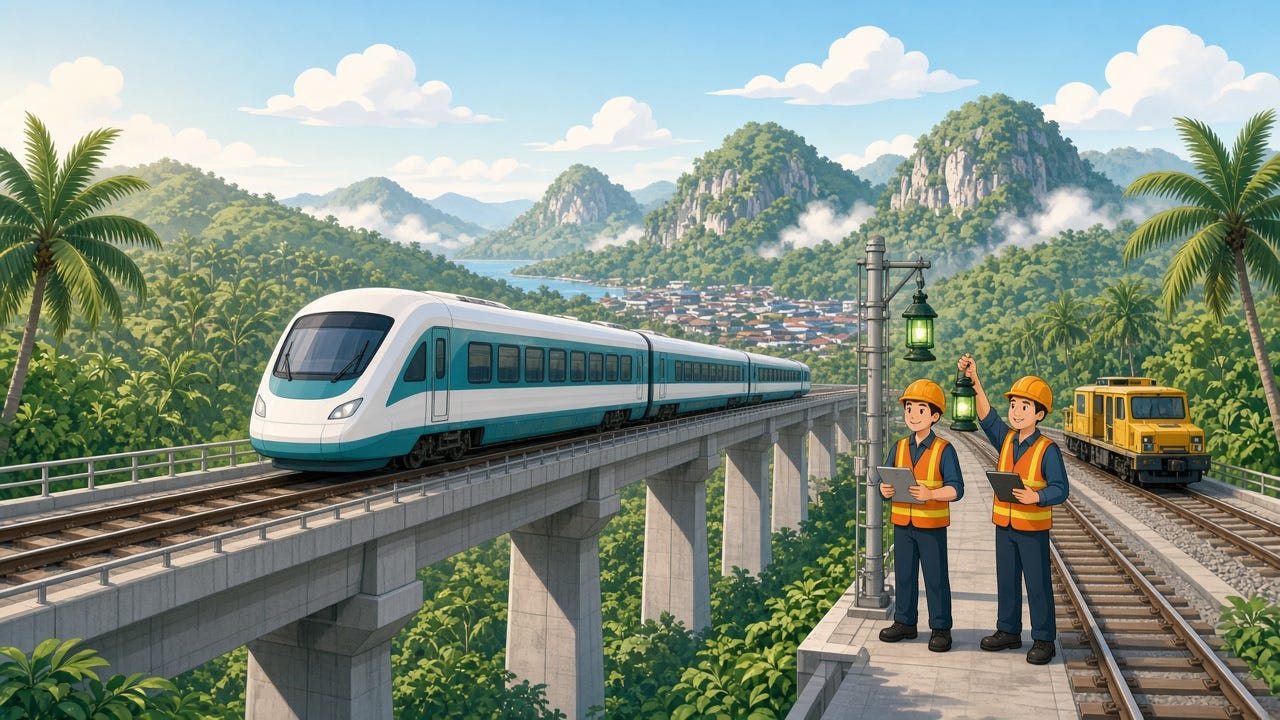
The yellow-striped Comprehensive Inspection Train, nicknamed the “yellow doctors”, completed a non-stop 519km run from Gombak to Kota Bharu in three hours and 19 minutes at up to 160km/h. By October, train testing had covered more than 50,000km, The Malaysian Reserve reported.
Transport Minister Anthony Loke has confirmed a 12 December target, ticket sales from mid-November and a 30% discount on economy fares for the first month, all “subject to the completion of safety requirements and the necessary approvals”. MRL chief executive Datuk Seri Darwis Abdul Razak has stressed that the compressed timeline does not mean “compromising on safety, quality or the integrity of the testing and commissioning process.”
RTS Link: built, but not yet ready
The cross-border RTS Link shows the other side of the same coin. In an October joint statement, Singapore’s Land Transport Authority and Malaysia’s Ministry of Transport said infrastructure works in both countries were “substantially complete”, yet passenger service is now expected in February 2027.
The sequence explains why. The operator, RTS Operations, expects to finish final system tests and trial runs by 31 December 2026. It must then obtain certification from an independent safety assessor, after which authorities in both countries review the results before granting approval to open. Two regulators, one independent assessor and a border make the commissioning chain longer than any domestic line.
Pan Borneo Sabah: the road version
Highways face a similar squeeze. Contractors on three critical Sabah Pan Borneo packages, WP06 to WP08 around the Kota Kinabalu Outer Ring Road, have been told to finish by year-end, according to the New Straits Times. The packages are said to be 95% complete but cannot fully open while several sections remain under construction.
The broader picture is sobering. The Auditor-General’s Report 2/2026 found only four of Phase 1’s 35 packages fully completed as of 31 March, although that counts finished packages, not physical progress, which the state put at 89.54% for Phase 1A in late September against a scheduled 96.23%.
The international lesson: commissioning is a project in itself
Malaysia is not alone. London’s Elizabeth line, the Crossrail project, was due to open in December 2018 but did not carry passengers until May 2022, largely because integrating signalling and train software across three different systems took far longer than planned. The tunnels had been finished years earlier.
The lesson for owners and contractors is to treat testing, integration and certification as a full work package with its own schedule, budget and float, rather than the tail end of construction. That means:
Planning commissioning early. Signalling, power and communications interfaces should be tested in the factory and in stages, not all at the end.
Engaging regulators and assessors from day one, so certification evidence is gathered as the work progresses.
Being honest about “per cent complete”. Physical progress of 98% says little about operational readiness, as both ECRL and RTS show.
What to watch
Over the next six weeks, watch for ECRL’s trial operations and ticket sales in mid-November, RTS Link’s final system tests before 31 December, and whether Sabah’s Kota Kinabalu bypass packages meet their year-end deadline. Further out, ECRL’s Gombak–Port Klang section, which will link the line to Westports and Northport, is expected to take about another year.
For Malaysian contractors, the message is clear. Clients increasingly reward teams that can deliver the last two per cent smoothly, not just the first ninety-eight. Systems integration, testing and documentation skills are becoming as valuable as piling rigs and launching gantries.
Sources: The Star, Malay Mail, The Malaysian Reserve, Land Transport Authority Singapore, New Straits Times.