


💼 Market & Business Insight · Friday, 30 October 2026
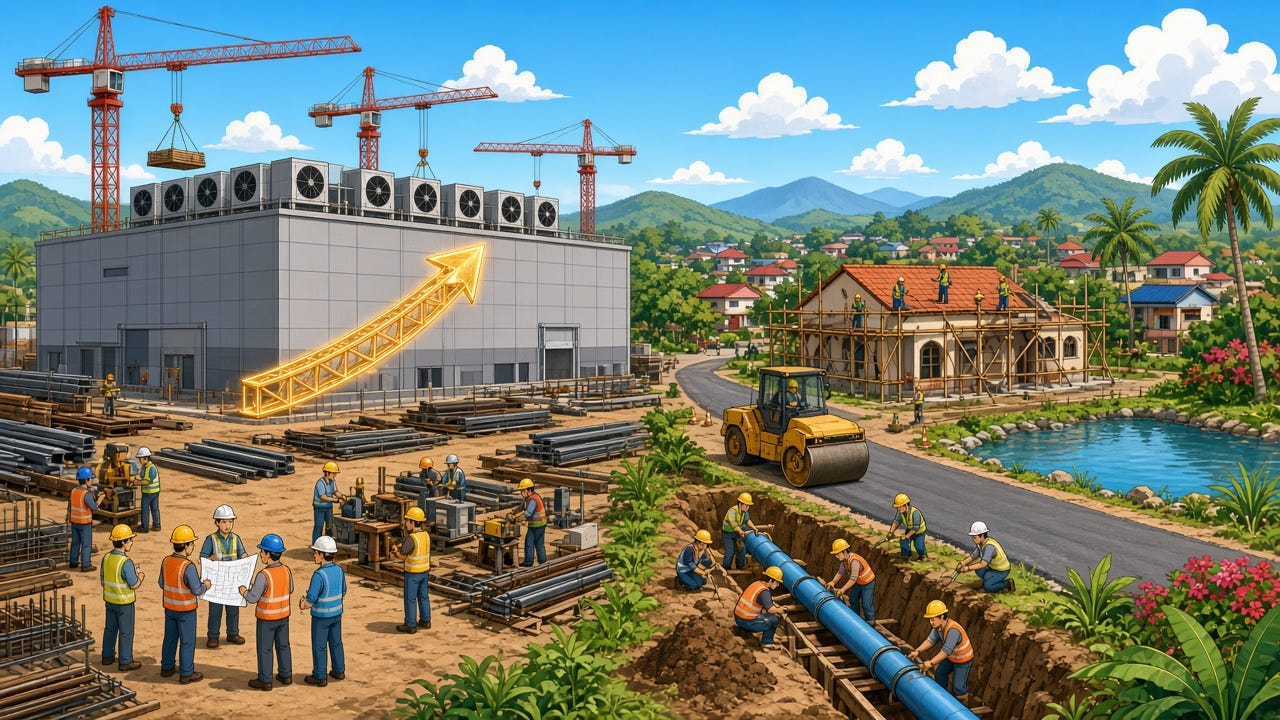
Malaysia’s construction boom is splitting in two. On one side, hyperscale data centres are keeping the biggest contractors’ order books full. On the other, Budget 2027 has handed the industry RM83 billion in development spending but almost no new mega projects. Instead, the money is spread across water pipes, flood ponds, rural roads and school repairs. For every contractor, the question for 2027 is simple: which half of the market are you built for?
Growth is still solid, but it is cooling
The headline numbers are healthy. The Department of Statistics Malaysia’s advance GDP estimate for Q3 2026 has construction growing 6.0% year on year, down from 6.5% in the previous quarter. DOSM’s media release says growth was supported by non-residential buildings, “particularly data centre construction projects”, and by specialised construction activities.
The mix is clearer in the latest full quarterly release. In Q2 2026, value of work done reached RM47.8 billion, up 8.8%. Special trade activities grew 17.6% and non-residential buildings 13.3%, while civil engineering, the segment most tied to public infrastructure, grew only 2.7%. Specialist and private building work is carrying the cycle. Public civil works are not. The Q3 construction statistics are due on 12 November.
What Budget 2027 actually offers
Budget 2027 sets development expenditure at RM83 billion. Hong Leong Investment Bank (HLIB) Research compares that with an estimated RM81 billion for 2026, plus RM11 billion in public-private partnership (PPP) investment (Business Today). UOB Kay Hian puts the total public development spend, including statutory bodies and government-linked investment companies, at RM133.2 billion against RM131.8 billion (UOB Kay Hian).
Analysts agree on what is missing. UOB Kay Hian notes a “lack of new mega projects announced” and limited visible pipeline for the large contractors it covers, and rates the budget neutral for the sector. Instead, the spending is spread wide:
RM2.5 billion for the National Non-Revenue Water programme, replacing about 1,900 km of ageing pipes
RM3.3 billion for Sabah and Sarawak roads, with the Limbang and Lawas sections of the Trans Borneo Highway expected to be awarded by end-2026
RM1.3 billion to upgrade 682 dilapidated schools, mainly in Sabah and Sarawak
RM100 million for retention ponds and river maintenance in the Klang Valley, plus flood mitigation schemes in Melaka, Kelantan, Terengganu and Kuching
The proposed elevated autonomous rapid transit (e-ART) in Johor Bahru, ahead of the RTS Link opening in 2027
Most of these are packages a mid-sized or small contractor can bid for. Few of them would move the order book of a large-cap player.
A deliberate tilt to smaller contractors
The procurement rules point the same way. In the Budget 2027 speech, the government raised procurement reserved for G1 to G4 Bumiputera contractors to RM7.5 billion, from RM4 billion this year. For maintenance, repair and upgrading of government facilities, direct awards are allowed up to RM200,000 and quotations up to RM3 million. The speech also earmarks a RM1.5 billion centralised solar park for government buildings, framed as work for Bumiputera construction, engineering and maintenance firms.
Cost relief is aimed at the same group. The budget reinstated the Variation of Price (VOP) clause for diesel and bitumen increases on public projects. UOB Kay Hian says this should mainly help smaller contractors with infrastructure-heavy order books, while the planned minimum wage rise from RM1,700 to RM2,000 looks manageable for large caps that already pay most workers above the current floor. HLIB is more cautious and calls the wage increase generally negative for labour-intensive contractors.
The big end of town is betting on private work
Large contractors are relying on private demand instead. HLIB says the data centre investment boom remains the key earnings catalyst for major players and keeps Gamuda and Inta Bina as top picks. UOB Kay Hian’s top picks are Gamuda, IJM, Sunway Construction, Binastra and Kerjaya. The common thread is balance-sheet strength and data centre or private building exposure. The RM11 billion PPP pot favours the same firms, because PPP projects need financing capacity as well as construction capability.
The American warning sign
The United States shows what happens when that split widens. In the Associated Builders and Contractors (ABC) September survey, reported by Construction Dive, average backlog rose to 8.7 months. The detail underneath matters more. About four in ten contractors with revenue above US$100 million have data centre work, compared with 10% of smaller firms. Contractors with data centre contracts reported 11.3 months of backlog, a full three months more than those without. ABC’s chief economist Anirban Basu said the gulf between construction’s winners and losers is growing wider, and more than one in four contractors expect margins to shrink over the next six months.
Dodge Construction Network data cited by Construction Dive shows the concentration: projects above US$1 billion now take about one in every four dollars of US non-residential construction spending.
What this means for Malaysian builders
The money is there in 2027, but it will arrive in different forms depending on the size of the firm:
Large caps: data centre and PPP work will drive results. The risk is concentration. If hyperscale demand slows, few public mega projects are waiting to replace it.
Mid-tier contractors: water, flood and East Malaysian road packages are the real opportunity. Tendering capacity and cash flow will matter more than headline size.
Small and G1–G4 firms: the higher reserved procurement and direct-award limits are meaningful. Winning repeat maintenance and school-upgrade work, and claiming VOP properly, will decide margins.
Suppliers: pipe makers, M&E specialists and precast producers sit on both sides of the market. HLIB already flags pipe manufacturers as beneficiaries of the NRW programme.
The bottom line
Budget 2027 doesn’t shrink the construction market. It spreads it out. The growth story at the top is private and digital, while the public story is many small, practical jobs. The US experience suggests the gap between those two markets can widen quickly. Malaysian contractors should decide now which pipeline they are built for and price their bids for that market.
Sources
DOSM – Advance GDP Estimates Q3 2026: https://www.dosm.gov.my/portal-main/release-content/advance-gross-domestic-product-gdp-estimates-q32026
DOSM – Advance GDP Q3 2026 media release: https://www.dosm.gov.my/uploads/release-content/file_20261016103547.pdf
DOSM – Construction Statistics, Second Quarter 2026 (13 Aug 2026): https://www.dosm.gov.my/portal-main/release-content/construction-statistics-q22026
Business Today – Despite Lacking New Big Projects Under Budget 2027, RM83 Billion Should Benefit Large-Cap Contractors (10 Oct 2026): https://www.businesstoday.com.my/2026/10/10/despite-lacking-new-big-projects-under-budget-2027-rm83-billion-should-benefit-large-cap-contractors/
UOB Kay Hian – Construction: Budget 2027 Neutral; Marginal Lift From Expansionary Stance (14 Oct 2026): https://uobkh.com.my/en/research/sector-my-construction-14102026
Ministry of Finance – Speech: The Fifth MADANI Budget 2027: https://www.mof.gov.my/portal/en/news/speech/speech-the-fifth-madani-budget-2027
Construction Dive – Contractors’ backlog jumped in September as profit outlook fell (14 Oct 2026): https://www.constructiondive.com/news/contractors-backlog-jumped-september-profit-outlook-fell/832949/
Construction Dive – Megaprojects grab 1 in 4 nonresidential construction dollars: https://www.constructiondive.com/news/megaprojects-grab-1-in-4-nonresidential-construction-dollars/832256/